Best 3D Printers for Miniatures (2026) – Expert Picks for Perfect Detail
Miniatures are where 3D printers either shine… or get exposed.
A “good” printer for toys or brackets can still struggle with:
- tiny faces and sharp edges
- swords that turn into noodles
- layer lines that look like tree rings
- supports that weld themselves to the model
So this guide is built around miniature reality, not generic 3D printer talk.
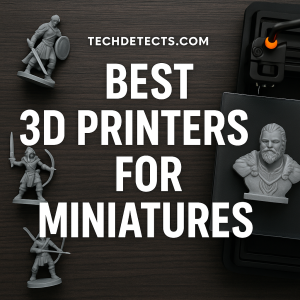
You’ll see two clear lanes:
- Resin (MSLA) printers — best detail for tabletop minis, figures, busts.
- FDM filament printers — better for terrain, big props, and durable pieces (and can do minis decently with the right nozzle + profiles).
Updated for 2026 and written for a global audience.
Quick Picks (TL;DR)
- Best overall resin printer for miniatures: ELEGOO Saturn 4 Ultra 16K
- Best beginner resin printer (easy + high detail): ELEGOO Mars 5 Ultra 9K
- Best budget resin printer that still prints crisp minis: Anycubic Photon Mono 4 (10K)
- Best small-format “detail monster” resin printer: Phrozen Sonic Mini 8K S
- Best mid-size resin printer for squads/armies: Anycubic Photon Mono M5s Pro (14K)
- Best “smart workflow” resin printer (sensors + app): Phrozen Sonic Mighty Revo (14K)
- Best premium resin printer for bigger batches + stable temps: UniFormation GKTwo
- Best FDM option for terrain + decent minis: Bambu Lab A1 mini (with 0.2mm nozzle)
- Best essential accessory: ELEGOO Mercury XS (Wash + Cure)
Resin vs FDM for miniatures (choose this first)
Resin (recommended for character minis)
Pros
- The sharpest detail (faces, armor texture, tiny runes)
- Smooth surfaces with minimal layer lines
- Thin weapons and fine parts look more “store-bought”
Cons
- Messy workflow (resin, IPA, curing)
- Safety needs (gloves, ventilation)
- Prints are more brittle than FDM
FDM (great for terrain and rugged pieces)
Pros
- Cleaner workflow (no liquid resin)
- Stronger prints for terrain/props
- Cheaper “big volume” printing
Cons
- Fine detail is harder (even with 0.2mm nozzle)
- Supports can leave more marks
If you’re mainly printing 28–32mm tabletop figures: start with resin. If you’re mainly printing dungeons/terrain: FDM is often the smarter first buy.
What matters for miniature print quality
1) XY resolution (resin)
Lower micron pixel size usually means sharper small details. But don’t chase numbers only — a good light system and consistent exposure matter too.
2) Stability + leveling
Miniatures punish wobble. Auto-leveling / rigid rails / good vat & plate design help you avoid “mystery failures.”
3) Supports are half the quality
Great minis come from:
- good support strategy (light + medium mix)
- correct lift settings
- correct resin temperature
4) Temperature matters (especially resin)
Cold resin prints can fail, warp, or lose detail. Heated vats/chambers are not just “luxury”—they’re consistency.
Best 3D Printers for Miniatures (2026)
ELEGOO Saturn 4 Ultra 16K
Why it’s here: This is the current “sweet spot” for miniatures: big enough for squads and multi-part models, sharp enough for character detail, and designed for faster, more reliable printing.
Who it’s for: Anyone serious about miniatures who wants a modern, high-detail resin printer without jumping into ultra-premium pricing.
What it solves:
- Excellent detail for minis and busts
- Large build area for printing armies in fewer runs
- Faster workflow features (speed + smart protections depending on region/model)
Trade-offs: Bigger resin printer = bigger mess footprint. You’ll want a wash/cure setup.
ELEGOO Mars 5 Ultra 9K
Why it’s here: A strong “first resin printer” because it focuses on detail and consistent results in a more manageable size.
Who it’s for: Beginners and tabletop hobbyists printing mostly single minis, small squads, and detailed accessories.
What it solves:
- High-detail prints without needing a huge machine
- More affordable entry into “proper miniature detail”
- Easier to manage than big-format resin printers
Trade-offs: Smaller build volume means more batches for armies.
Anycubic Photon Mono 4 (10K)
Why it’s here: One of the best value picks if you want crisp minis at the lowest price tier.
Who it’s for: Budget buyers who still want real miniature-level detail.
What it solves:
- Excellent detail-per-dollar
- Great for starter armies, characters, bits and bases
- Widely supported ecosystem and community profiles
Trade-offs: Less “premium automation” than higher tiers; you’ll rely more on your settings.
Phrozen Sonic Mini 8K S
Why it’s here: If your goal is maximum detail in a compact format, this is a long-time favorite “mini printer” category.
Who it’s for: Painters, display mini builders, and anyone who wants top detail for single characters and small pieces.
What it solves:
- Very sharp detail for faces, textures, and small parts
- Compact footprint, easy to keep in a controlled workspace
- Strong community support for miniature-oriented settings
Trade-offs: Not ideal for big batch production.
Anycubic Photon Mono M5s Pro (14K)
Why it’s here: A great option when you want both detail and “army printing” volume in one machine.
Who it’s for: Tabletop players building armies, anyone printing multiple minis per run.
What it solves:
- High resolution in a bigger format
- Great for printing squads, vehicles, monsters, terrain bits
- Good ecosystem and resin compatibility
Trade-offs: Bigger printers cost more to run (more resin, bigger wash/cure needs).
Phrozen Sonic Mighty Revo (14K)
Why it’s here: This one is about workflow confidence: smart sensors, residue detection, and app access can make resin printing feel less stressful.
Who it’s for: People who hate failed prints and want “smarter” resin printing day-to-day.
What it solves:
- Strong mid-size capacity for squads + pieces
- Smart monitoring features (varies by firmware and region)
- Great detail for tabletop minis
Trade-offs: Usually pricier than “pure value” picks.
UniFormation GKTwo
Why it’s here: This is the “stable temperature, premium workflow” resin pick that mini painters and serious hobbyists love — especially if your room temp varies.
Who it’s for: Enthusiasts printing often, in colder climates, or anyone wanting consistent results with fewer temperature-related failures.
What it solves:
- Heated resin system / temperature stability
- Big build volume for batches
- Premium build feel and community support
Trade-offs: Higher price, larger footprint.
Best FDM printer for miniatures (and why you might choose it)
Bambu Lab A1 mini (with 0.2mm nozzle)
Why it’s here: If you want the cleanest “plug-in-and-print” FDM experience for terrain, props, and durable parts — but still want minis that look surprisingly good at tabletop distance.
Who it’s for: People printing mostly terrain and larger pieces, or anyone who doesn’t want resin handling.
What it solves:
- Much cleaner workflow than resin
- Great for terrain, bases, buildings, and durable gaming pieces
- With a 0.2mm nozzle + good profiles, mini quality can be “good enough” for many tabletop gamers
Trade-offs: Resin still wins for faces, fine texture, and truly clean miniature detail.
Must-have accessory (resin)
ELEGOO Mercury XS (Wash + Cure)
Why it’s here: A wash/cure station turns resin printing from “sticky chaos” into an actual repeatable hobby workflow.
Who it’s for: Anyone buying a resin printer (seriously — budget for this).
What it solves:
- Cleaner prints (better washing)
- More consistent curing
- Less mess and less handling time
Trade-offs: Adds cost and takes space — but it saves sanity.
Safety (quick, real-world)
Resin is not “toxic doom,” but it’s not harmless either.
- Wear nitrile gloves
- Use ventilation (open window + fan, or enclosure)
- Avoid skin contact
- Cure and dispose waste properly
If you can’t ventilate at all, consider FDM first.
Miniature settings that usually work (starter baseline)
(Exact numbers vary by printer + resin — but this is a practical starting mindset.)
Resin minis
- Layer height: 0.05mm for gaming minis, 0.03mm for display
- Use “light supports” where possible + stronger supports on heavy overhangs
- Keep resin warm and consistent
FDM minis
- Nozzle: 0.2mm (or 0.25mm on some systems)
- Layer height: 0.06–0.10mm
- Slow outer walls, good cooling
- Tree supports (or tuned support interface)
Which one should you buy?
- I want the best overall mini results without going ultra-premium: ELEGOO Saturn 4 Ultra 16K
- I’m new and want reliable high detail in a smaller size: ELEGOO Mars 5 Ultra 9K
- I want the cheapest “real minis” resin printer: Anycubic Photon Mono 4
- I want maximum detail for single figures: Phrozen Sonic Mini 8K S
- I want to print squads/armies efficiently: Anycubic Photon Mono M5s Pro or Phrozen Sonic Mighty Revo
- I want consistent results even in colder rooms: UniFormation GKTwo
- I want to avoid resin entirely (terrain first): Bambu Lab A1 mini (0.2mm nozzle)
Comparison Table
| Printer | Type | Best for | Biggest strength | Main trade-off |
|---|---|---|---|---|
| ELEGOO Saturn 4 Ultra 16K | Resin MSLA | Best overall minis | Detail + batch capacity | Bigger footprint |
| ELEGOO Mars 5 Ultra 9K | Resin MSLA | Beginners | High detail in manageable size | Smaller volume |
| Anycubic Photon Mono 4 | Resin MSLA | Budget minis | Value + crisp detail | Less automation |
| Phrozen Sonic Mini 8K S | Resin MSLA | Maximum detail | Tiny features + smooth surfaces | Not for big batches |
| Anycubic Photon Mono M5s Pro | Resin MSLA | Army printing | Large format + detail | Higher consumable needs |
| Phrozen Sonic Mighty Revo | Resin MSLA | Smart workflow | Sensors + strong detail | Usually pricier |
| UniFormation GKTwo | Resin MSLA | Premium consistency | Heated system + stability | Expensive |
| Bambu Lab A1 mini (0.2) | FDM | Terrain + decent minis | Clean workflow + ease | Resin still sharper |
| ELEGOO Mercury XS | Accessory | Resin workflow | Wash + cure consistency | Extra cost/space |
Conclusion
If your goal is beautiful character minis, resin is still the king.
The best “do it all” miniature resin pick right now is the ELEGOO Saturn 4 Ultra 16K — sharp enough for characters, big enough for squads.
If you’re just starting and want a smaller, easier machine, ELEGOO Mars 5 Ultra 9K is a safer first step.
And if you mainly want terrain and rugged pieces without resin mess, get the Bambu Lab A1 mini, add the 0.2mm nozzle, and enjoy a much cleaner hobby workflow.
If you are interested in stickers then we recommend checking out Best Printers for Envelopes – Top Picks for Quality & Efficiency.