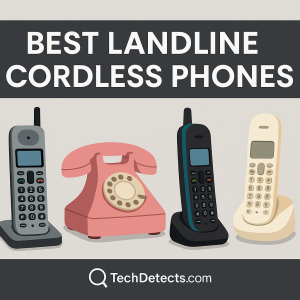
Best Cordless Home Phones in 2026: Clear Calls, Long Range & Call Blocking
Cordless landline phones are one of those “boring” products you only notice when they’re bad.
A good one disappears into the background:
- clear audio
- stable range across rooms
- call blocking that actually reduces spam
- handsets that don’t die after a year
This guide is written for a global audience and focuses on real home use, not office PBX systems.
Quick Picks (TL;DR)
- Best overall for most homes (spam blocking + reliability): Panasonic KX‑TGF975 / KX‑TGF97x series (Link2Cell)
- Best “corded base + cordless handsets” system: AT&T CL84207 (Smart Call Blocker)
- Best “connect your cell phones to the home system”: VTech DS6521 (Connect to Cell)
- Best for seniors / hearing assistance (big buttons + loud): Panasonic KX‑TGM420 (and expansion handsets)
- Best simple DECT set for Europe/UK (great value): Panasonic KX‑TGJ320 (region-specific)
What to look for in a cordless landline phone
1) DECT matters (and it’s regional)
- North America: “DECT 6.0” usually means the 1.9GHz band.
- Europe/UK: DECT is common too, but models and naming differ.
The practical takeaway: buy a model intended for your region.
2) Call blocking is now a top feature
If you get spam/robocalls, look for:
- large block lists
- one-touch call block button
- caller ID announce / screening
3) Battery + charging design
Look for:
- common battery types (easy replacements)
- a base/handset design that seats easily
- a system that still works in a power outage (some do, some don’t)
4) Multi-handset coverage
If your home is multi-floor, prioritize:
- bundled handsets (2–5)
- expandable systems
- placing chargers strategically (not all bases are “repeaters,” but extra handsets reduce missed calls)
5) If you use VoIP or a fiber “phone port”
Many homes now plug a phone into:
- a router/ONT phone port
- an ATA adapter
Cordless systems usually work fine with these, but caller ID behavior can vary by provider.
Best Landline Cordless Phones (2026)
Panasonic KX‑TGF975 / KX‑TGF97x series (Link2Cell)
Why it’s here: This is one of the best “modern home phone” systems because it combines great usability with serious call blocking, plus Bluetooth cell pairing (Link2Cell) so you can use your home handsets for cell calls.
Who it’s for: Families who want fewer spam calls, strong range, and a feature-rich system that feels like a real upgrade.
What it solves:
- Strong spam reduction: advanced call blocking includes a large pre-installed block list and manual blocking
- Bluetooth “Link2Cell” lets you pair up to two cell phones and use the cordless handsets around the house
- Built-in answering system and a large phonebook on many configurations
Trade-offs: Larger base/handset footprint. Feature-rich menus can feel “busy” for some users.
AT&T CL84207 (corded base + cordless handsets)
Why it’s here: A very practical system when you want a corded base (great for a kitchen desk or home office) plus cordless handsets around the house. It’s also designed around call screening/robocall handling.
Who it’s for: Home offices, families that still like a corded base, and anyone who wants “pick up and talk” reliability.
What it solves:
- Corded base + cordless handsets in one package
- Smart Call Blocker features and caller ID announce style workflow
- Big buttons and easy visibility for daily use
Trade-offs: Design is more traditional; menus are functional rather than modern.
VTech DS6521 (Connect to Cell)
Why it’s here: If your landline use is decreasing but you still want a “home phone system,” a Connect‑to‑Cell model is a smart bridge: it lets you use cordless handsets for your cell calls (Bluetooth pairing).
Who it’s for: People who often leave their phone charging somewhere and want calls everywhere in the house.
What it solves:
- Make/receive cell calls from multiple handsets (Bluetooth pairing)
- Great for families sharing a home system
- Built-in answering system on many bundles
Trade-offs: Bluetooth range is limited; keep the paired phone reasonably close to the main base.
Panasonic KX‑TGM420 (amplified / senior-friendly)
Why it’s here: If someone in the home needs louder volume, clearer speech, and simpler controls, amplified cordless systems are a different category — and worth it.
Who it’s for: Seniors, hearing assistance needs, or anyone who struggles with low call volume.
What it solves:
- Much louder maximum volume than typical cordless phones
- Better clarity emphasis for speech
- Easy-to-use physical controls
Trade-offs: Not designed for “smart home” features. It’s built for clarity and simplicity.
Best cordless phone for Europe/UK readers
Panasonic KX‑TGJ320 (region-specific)
Why it’s here: In the UK/EU market, Panasonic’s DECT sets remain a common value pick with good clarity and practical features like an answering machine and shared phonebook (bundle dependent).
Who it’s for: UK/EU households that want a straightforward DECT phone with solid value.
Trade-offs: Availability and exact features vary by country bundle.
How many handsets do you really need?
- Small apartment / single floor: 1–2 handsets
- Two floors: 2–3 handsets
- Large home: 4–5 handsets (or a system with excellent range + strategic placement)
If you miss calls because the handset is in the wrong room, buy more handsets — it’s cheaper than frustration.
Features that are worth paying for
Call blocking + caller ID announce
If spam is a problem, prioritize this above everything.
Intercom + paging (find my handset)
If you’ve ever lost a handset in sofa cushions, you already know why this matters.
Power outage support
Some systems support limited calling in a power outage (often via the base + charged handset). If this is important, verify it on the exact model.
Cell link / Bluetooth
If you rarely use your landline, Link2Cell/Connect‑to‑Cell can make your cordless phones useful again.
Recommended picks by scenario
- I want the best overall modern home system: Panasonic KX‑TGF975 / KX‑TGF97x
- I want a corded base + cordless handsets: AT&T CL84207
- I want to use my cordless handsets for cell calls: VTech DS6521
- I need louder, clearer calls: Panasonic KX‑TGM420
- I’m in the UK/EU: Panasonic KX‑TGJ320 (or the closest current regional equivalent)
Comparison Table
| Model | Best for | Key strength | What to watch |
|---|---|---|---|
| Panasonic KX‑TGF975 / TGF97x | Best overall | Advanced call blocking + Link2Cell | Larger footprint |
| AT&T CL84207 | Corded base setup | Smart call blocking + corded base | Traditional UI |
| VTech DS6521 | Cell integration | Connect‑to‑Cell convenience | Bluetooth distance |
| Panasonic KX‑TGM420 | Seniors/hearing | Amplified clarity | Less “smart” |
| Panasonic KX‑TGJ320 | UK/EU value | Simple DECT + answering | Country bundles vary |
Conclusion
If you want a cordless landline phone system that feels like a real upgrade in 2026, buy based on the problem you actually want solved.
For most homes, the best overall choice is the Panasonic KX‑TGF975 / KX‑TGF97x series because it combines strong call blocking with everyday usability — and cell pairing makes it far more useful than a “landline-only” phone.
If you want a corded base for reliability, go with the AT&T CL84207. If your goal is using cordless handsets for your cell calls, VTech DS6521 is a very practical pick.
You might also want to check out Best Computer Speakers Under $100– Smart Audio for Every Desk.