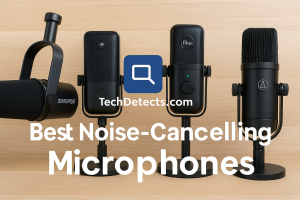
Best Noise-Cancelling Microphones (2026) — The Mics That Actually Cut Through Background Noise
“Noise-cancelling microphone” is one of the most misunderstood phrases in audio.
A lot of people read it and imagine some magical mic that simply deletes all background noise by itself.
That is not really how it works.
In the real world, the best microphones for noisy rooms, keyboard-heavy desks, untreated spaces, gaming setups, shared homes, and work calls usually win for one of three reasons:
- they naturally reject room noise because of their microphone type and pickup pattern
- they let you place the mic close to your mouth, which improves voice-to-noise ratio dramatically
- they combine good hardware with useful software processing such as noise gates, filters, or AI cleanup
That is why this guide is not built around hype words.
It is built around the microphones that actually make sense if your goal is cleaner voice pickup with less background distraction.
For some people, that means a dynamic USB microphone that rejects room noise better than a condenser. For others, it means a hybrid USB/XLR mic that grows with them. For some, it means a compact gaming mic with smart software filters. And for certain buyers, it means accepting that microphone technique matters just as much as the mic itself.
So this article focuses on what actually matters:
- background-noise rejection in real use
- microphone type and pickup pattern
- how forgiving the mic is in untreated rooms
- whether it is better for meetings, streaming, podcasting, gaming, or voiceovers
- whether the value is in the hardware alone or in the software ecosystem too
Because that last part matters a lot.
A microphone can sound amazing in a studio and still be the wrong buy for a noisy bedroom, a room with fans running, or a desk full of keyboard noise. The best noise-rejecting microphone is often not the most glamorous one — it is the one that lets your voice stay clear in your actual environment.
Quick Picks
- Best overall noise-rejecting microphone: Shure MV6
- Best USB/XLR hybrid for noisy rooms: RØDE PodMic USB
- Best value USB/XLR noise-rejecting mic: Audio-Technica ATR2100x-USB
- Best gaming mic with software-assisted cleanup: Logitech G Yeti GX
- Best simple streaming mic for single-voice focus: JBL Quantum Stream Talk
- Best XLR-only dynamic option for room-noise rejection: Elgato Wave DX
- Best flashy creator mic that is still more usable in noisy spaces than many condensers: HyperX QuadCast 2 S
What actually matters in a noise-cancelling microphone
Dynamic microphones usually make more sense for noisy spaces
This is the most important buying principle in the category.
If your room is not acoustically treated, a dynamic microphone is often the smarter choice than a condenser.
Why?
Because dynamic mics usually pick up less of the room, less of the keyboard, and less of the general “space around you” when used properly up close. That makes them much easier to recommend for:
- gaming desks
- untreated bedrooms
- shared workspaces
- fan noise and PC hum
- voice-heavy streaming or podcasting
This is exactly why so many of the best microphones for background-noise rejection are dynamic models.
Pickup pattern matters too
Cardioid and supercardioid microphones are often the most useful here because they focus on your voice and reject more sound from the sides or rear than broader patterns do.
But pattern alone is not the whole story.
A great cardioid microphone with poor placement can still sound messy. A well-placed dynamic microphone will often beat a more expensive mic used badly.
Distance changes everything
A mic that sits far away on a desk will hear more room.
A mic that sits closer to your mouth will hear more you.
That is why boom arms, careful mic positioning, and proper speaking distance matter so much. The microphone is only part of the system.
Software cleanup can help — but it should not have to rescue a bad setup
Some microphones now offer:
- onboard DSP
- noise gates
- EQ presets
- software-based key-click reduction
- voice enhancement
- app-based tuning
That can be very useful.
But the smartest buying approach is still this:
Start with a microphone that already rejects noise well physically. Then treat software as the bonus, not the rescue plan.
Your use case matters more than marketing labels
A microphone for noisy Zoom calls is not always the same best choice as a microphone for streaming or voiceover work.
Some buyers need:
- plug-and-play simplicity
- compact design
- USB-only convenience
Others care more about:
- future XLR upgrades
- stronger vocal depth
- better arm-mounted podcast workflow
- more control over sound shaping
That is why the shortlist below is not all one type of mic.
Best Noise-Cancelling Microphones
Shure MV6 — Best Overall Noise-Rejecting Microphone
Why it’s here: This is one of the easiest premium recommendations right now for people who want a dynamic USB mic that is clearly built for voice in real-world setups, not just in ideal rooms.
Who it’s for: Streamers, gamers, remote workers, and creators who want strong voice isolation without needing to build a full XLR setup.
What it nails
- dynamic design makes it a naturally smarter fit for noisy spaces than most USB condensers
- modern USB convenience with a more serious voice-first sound profile
- Shure’s software ecosystem adds useful tuning and cleanup options
- strong balance of simplicity, vocal presence, and real-world practicality
- easy recommendation for people who want a “just sounds right” voice mic
Real-world experience
The MV6 feels like a microphone made by people who understand exactly why so many users are frustrated by condenser mics on noisy desks.
It is not trying to impress with broad studio-room sensitivity. It is trying to make spoken voice sound focused and clean in ordinary setups. That makes it one of the smartest all-round buys in this category.
For many people, this is the point where “noise-cancelling microphone” finally starts meaning something useful in practice.
Trade-offs: It is not the cheapest mic here, and some buyers will still prefer a USB/XLR hybrid for longer-term upgrade flexibility.
RØDE PodMic USB — Best USB/XLR Hybrid for Noisy Rooms
Why it’s here: This is one of the best examples of a microphone that gets the fundamentals right: dynamic capsule, close-up vocal use, USB convenience, XLR future-proofing, and useful onboard DSP tools.
Who it’s for: Buyers who want a microphone that works now over USB but can also grow into a more serious audio setup later.
What it nails
- dynamic broadcast-style voicing is excellent for room-noise rejection
- USB and XLR in one mic make it unusually flexible
- built-in DSP tools add real value for people who want cleaner results without extra gear
- strong fit for podcasting, streaming, voiceover, and desk setups with some noise around them
- one of the smartest long-term buys in the category
Real-world experience
The PodMic USB is easy to recommend because it solves two problems at once.
First, it is simply a strong noise-rejecting voice microphone. Second, it avoids the classic “buy twice” trap. You can start with USB, get great results, and still keep the microphone if you later move to an interface.
That flexibility makes it one of the most practical microphones here.
Trade-offs: It is more of a proper desk/arm mic than a tiny portable solution, and some buyers may prefer a cheaper route if they know they will never care about XLR.
Audio-Technica ATR2100x-USB — Best Value USB/XLR Noise-Rejecting Mic
Why it’s here: This remains one of the easiest value recommendations for people who want a dynamic voice mic without overspending.
Who it’s for: Budget-conscious buyers who want a real dynamic microphone with USB/XLR flexibility and better background-noise control than typical cheap USB condensers.
What it nails
- dynamic cardioid design still makes a lot of sense in noisy rooms
- USB-C and XLR combination is excellent for the price
- handheld form factor works well for voice-first use
- far more practical for real environments than many flashy budget condenser mics
- still one of the best starter picks in voice audio
Real-world experience
The ATR2100x-USB has stayed relevant for a reason.
It does not rely on gimmicks. It gives people what they actually need: a dynamic mic that sounds respectable, rejects background noise better than most budget desk condensers, and leaves room to grow. If your goal is simply to sound clearer in a normal room, this mic still makes a lot of sense.
Trade-offs: It is not the most luxurious-sounding or most feature-rich microphone on this list, but its value remains very strong.
Logitech G Yeti GX — Best Gaming Mic with Software-Assisted Noise Cleanup
Why it’s here: This is one of the smarter gaming-focused microphone releases because it combines a dynamic capsule with software features aimed at cleaning up the kind of noise gamers actually deal with.
Who it’s for: Gamers and streamers who want a modern USB mic with strong voice focus, software tuning, and a more polished gaming ecosystem experience.
What it nails
- dynamic capsule gives it a much better starting point than many RGB-heavy gaming condensers
- software can help reduce key clicks and keep voice levels more consistent
- USB simplicity makes it friendly for fast setup
- strong fit for streaming desks, gaming rooms, and creator setups with background noise challenges
- one of the more thoughtful gaming-mic options in the category
Real-world experience
This is the kind of mic that feels designed around real modern desk life.
Mechanical keyboard noise, voice consistency, quick setup, streaming workflow — those things matter, and the Yeti GX actually addresses them in a meaningful way. It is one of the better examples of software and hardware working together in a way that helps instead of just sounding flashy in marketing.
Trade-offs: It leans more gaming/streaming than neutral-broadcast studio style, and some buyers may prefer a simpler non-RGB microphone aesthetic.
JBL Quantum Stream Talk — Best Simple Streaming Mic for Single-Voice Focus
Why it’s here: This is one of the better “small but focused” USB microphones for buyers who want single-speaker capture without overcomplicating the setup.
Who it’s for: Streamers, casual creators, and work-from-desk users who want a compact mic with stronger voice focus than the average cheap USB option.
What it nails
- supercardioid-style single-voice focus is a smart fit for noise-conscious users
- compact, approachable design makes it easy to use in small setups
- plug-and-play usability is strong for people who do not want audio complexity
- good option when you want a cleaner voice presentation without a large arm-mounted dynamic setup
Real-world experience
The Quantum Stream Talk is appealing because it does not try to be everything.
It is aimed at a simple problem: one person at a desk who wants clearer voice pickup with less room around it. For the right buyer, that focused approach is exactly what makes it useful. It is not the most expandable option here, but it is one of the easier ones to live with.
Trade-offs: A compact condenser-style setup still cannot fully escape the laws of room acoustics, so it is less forgiving than a close-positioned dynamic mic when the environment gets really bad.
Elgato Wave DX — Best XLR-Only Dynamic Option for Room-Noise Rejection
Why it’s here: If you already have, or are willing to buy, an audio interface, this is one of the best pure voice mics for rejecting room mess while still sounding modern and clear.
Who it’s for: Streamers, podcasters, and creators who want a cleaner XLR path and care strongly about background-noise rejection.
What it nails
- dynamic design is naturally suited to untreated and noisy rooms
- voice sound stays detailed without turning into a room microphone
- excellent fit for boom-arm spoken-word setups
- one of the strongest “serious desk voice mic” choices for streamers on XLR
- very smart option if your entire goal is clean voice first
Real-world experience
The Wave DX is the kind of mic that wins by doing the core job well.
It does not need gimmicks. It is there to focus on the speaker, keep the room under control, and give creators a more professional voice sound without dragging in too much background distraction. If you are building a serious desk setup and do not mind XLR, it is one of the best choices in this whole category.
Trade-offs: XLR-only means more setup cost and less plug-and-play friendliness than USB or USB/XLR mics.
HyperX QuadCast 2 S — Best Flashy Creator Mic That Still Works Better Than Many Condensers in Noisy Setups
Why it’s here: This is not the purest background-noise-rejection pick here, but it deserves a place because it is a more capable and mature creator mic than many people assume.
Who it’s for: Buyers who want a feature-rich, visually striking USB mic and still care about getting reasonable voice focus in desk-heavy streaming or gaming environments.
What it nails
- richer feature set than many basic USB mics
- convenient controls, stand, and usability matter for creators
- more refined than a lot of “looks first, audio second” gaming microphones
- a good compromise for people who care about both presentation and practical voice capture
Real-world experience
The QuadCast 2 S is not here because it beats dynamic mics on raw room-noise rejection.
It does not.
It is here because many buyers will still want a stylish all-in-one creator mic, and among those options, this is one of the more serious ones. If you position it well, control gain sensibly, and use its features correctly, it can still be a respectable choice for people who want convenience and visual appeal without falling into the worst condenser-mic traps.
Trade-offs: If your room is genuinely noisy, a dynamic microphone from higher up this list is still the smarter buy.
Recommended Reading: Best Traveling Headphones — Comfort, ANC, Long Flights, and Real-World Portability
How to choose the right noise-rejecting mic for your setup
Choose the Shure MV6 if you want the safest overall recommendation
It is the easiest premium all-round voice mic here for people who want cleaner results in real rooms without building a full XLR chain.
Choose the RØDE PodMic USB if you want the best mix of quality and future-proofing
This is the smartest hybrid buy for people who may want to grow beyond USB later.
Choose the ATR2100x-USB if value matters most
It is still one of the best affordable ways to get proper dynamic-mic behavior.
Choose the Logitech G Yeti GX if you are a gamer or streamer who wants software help too
It is one of the more thoughtful gaming-focused mics for noisy desk setups.
Choose the JBL Quantum Stream Talk if you want small, simple, and voice-focused
It is a nice fit for compact desks and lower-complexity setups.
Choose the Elgato Wave DX if you want a serious XLR spoken-word microphone
This is the cleaner route for buyers building a more dedicated desk-audio chain.
Buying mistakes to avoid
Do not buy a condenser mic just because it is popular on streaming desks
A lot of famous USB condensers are simply the wrong tool for noisy rooms.
Do not place the mic too far away
Distance is one of the biggest reasons “noise-cancelling” setups fail.
Do not rely on software alone to save bad mic choice or bad placement
Good hardware and good positioning should do most of the heavy lifting.
Do not ignore your actual use case
Calls, gaming, streaming, podcasting, and voiceover work can all reward slightly different microphone choices.
Final Buying Advice
If you want the best noise-cancelling microphone for most people, the Shure MV6 is the strongest overall recommendation because it combines the right microphone type, modern convenience, and a voice-first design that makes sense in real noisy environments.
If you want the smartest long-term buy, the RØDE PodMic USB is one of the best choices on the market because it works beautifully now and still leaves room to grow later.
If your budget matters more, the Audio-Technica ATR2100x-USB remains one of the safest value picks in voice audio.
And if you are shopping specifically for a gaming or streaming desk, the Logitech G Yeti GX and JBL Quantum Stream Talk are the more tailored modern picks.
The biggest truth in this category is simple:
The best noise-cancelling microphone is usually not the one promising magic. It is the one whose design, placement, and workflow make your voice more dominant than the room around you.