Best VR Headsets for VRChat (2026) — The Right Picks for Social VR, Full-Body Tracking, Comfort, and Long Sessions
VRChat is not like most VR games.
That is exactly why buying a headset for VRChat is different from buying a headset for racing sims, rhythm games, or casual standalone VR.
In VRChat, the “best” headset is not just the one with the sharpest display or the newest chipset. It is the one that makes social VR feel better over time. That means comfort during long sessions, microphone and audio quality, controller feel, tracking reliability, PCVR compatibility, and — for some users — how far the headset can scale into full-body tracking, face tracking, or eye tracking.
That last part matters a lot.
Because one VRChat user may just want an affordable, easy way to hang out with friends in worlds and events. Another may care about full-body tracking dance sessions. Another may want expressive face and eye tracking for avatar performance. And another may simply want the lightest, most comfortable PCVR headset possible for multi-hour social use.
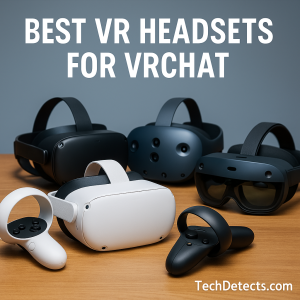
So this guide is not a generic “best VR headsets” list.
It is a VRChat-specific shortlist built around the things that actually matter in social VR:
- comfort for long sessions
- PCVR support and VRChat compatibility
- controller and tracking quality
- upgrade path into full-body tracking or face/eye tracking
- value depending on whether you want standalone simplicity or a serious SteamVR setup
- whether the headset feels great for being there, not just for benchmarking specs
VRChat itself supports a broad range of PC-compatible headsets, including Meta Quest via PC connection and SteamVR-compatible headsets, while its official docs also make clear that full-body tracking works through additional trackers in the Lighthouse ecosystem. That means your ideal headset depends heavily on whether you want a simple entry point or a more advanced expandable setup. )
Quick Picks
- Best overall for most VRChat users: Meta Quest 3
- Best value entry point for VRChat: Meta Quest 3S
- Best premium PCVR headset for comfort and social presence: Bigscreen Beyond 2e
- Best for full-body tracking and classic SteamVR social VR: Valve Index
- Best visual-upgrade pick for serious PCVR users: Pimax Crystal Light
- Best for eye tracking without going full custom niche: VIVE Focus Vision
- Best value high-end PCVR alternative with strong visuals: PlayStation VR2 for PC
What actually matters for a VRChat headset
Comfort matters more in VRChat than in many other VR games
A headset that feels fine for 30 minutes can feel terrible after three hours.
That matters a lot in VRChat, because this is one of the few VR experiences where people regularly stay in-headset for long stretches — chatting, attending events, dancing, world-hopping, or just hanging out.
So for VRChat, comfort is not a nice extra.
It is one of the main buying factors.
Weight, pressure distribution, face padding, heat, and overall wearability matter far more here than many first-time buyers expect.
Standalone convenience and PCVR depth are very different paths
Some headsets are great because they are easy.
Others are great because they scale.
A Quest headset is appealing because it gives you a simple way into VRChat and also lets you connect to PCVR later. A Lighthouse headset is appealing because it opens the door to stronger tracking ecosystems and better full-body options.
Neither path is automatically better. It depends on how serious you want to get.
Full-body tracking is not built into most headsets
This is one of the biggest VRChat misunderstandings.
When people talk about “full body,” they are usually talking about extra trackers — not just the headset itself.
VRChat’s official full-body tracking documentation explains support for additional tracking points through Lighthouse-ecosystem trackers such as Vive Trackers and Tundra Trackers. So if full-body is a priority, your headset choice should consider how naturally it fits into that broader tracking ecosystem. )
Face and eye tracking are still premium extras, not standard features
For expressive avatars and social presence, eye and face tracking can be a huge upgrade.
But this is still not the mainstream default.
VRChat’s creator docs also reference third-party tools such as VRCFaceTracking for driving avatar facial parameters through face and eye tracking hardware. That means the feature is real and important — but still more enthusiast-focused than plug-and-play mainstream. )
Good microphones and audio matter more than spec-sheet hype
VRChat is social.
That means you should care about:
- how you sound
- how comfortable it is to talk for hours
- whether built-in audio feels immersive enough
- whether headphone compatibility is easy
A technically impressive headset that sounds awkward or feels annoying in conversation can become less enjoyable than a “weaker” headset that simply feels more natural socially.
Best VR Headsets for VRChat
Meta Quest 3 — Best Overall for Most VRChat Users
Why it’s here: This is the easiest headset to recommend to the widest number of VRChat users because it balances usability, visual quality, standalone convenience, and PCVR flexibility better than anything else in the category.
Who it’s for: Most people — especially users who want a practical, modern, flexible headset that works well now and leaves room to grow later.
What it nails
- excellent balance of image quality, lens clarity, and overall ease of use
- works well as a standalone headset but also makes sense as a PCVR gateway
- much more comfortable visual experience than older fresnel-based Quest generations
- strong mainstream ecosystem and broad support make ownership easier
- one of the smartest “buy once and use for everything” VR choices
Real-world experience
This is the headset that makes the most sense for most VRChat users because it does not force you into a narrow path.
You can use it simply. You can use it with a PC. You can treat it like an entry point now and a better PCVR headset later. And crucially, it feels modern enough that you are not buying into outdated optics just to save a bit of money.
For social VR, that clarity matters. Quest 3 uses pancake optics and Meta positions it as its most powerful Quest with sharper visuals and stronger comfort than older models, which is exactly why it lands at the top for most buyers. )
Trade-offs: If your main goal is advanced Lighthouse full-body or the lightest premium PCVR comfort possible, this is not the final form of that journey.
Meta Quest 3S — Best Value Entry Point for VRChat
Why it’s here: For people who want the easiest affordable way into VRChat right now, this is the obvious answer.
Who it’s for: New VRChat users, budget-conscious buyers, and anyone who wants strong value without jumping straight to premium pricing.
What it nails
- excellent value for a modern all-in-one headset
- same broad ecosystem advantages that make Quest appealing in general
- easy recommendation for first-time VR users
- strong “try VRChat properly without overspending” option
- also leaves open a PCVR path later
Real-world experience
This is the headset for people who want in.
Not the most luxurious way in. Not the deepest enthusiast path. But one of the smartest ways in. Meta markets Quest 3S as delivering the same overall Quest 3 ecosystem experience with the XR2 Gen 2 platform, which is why it works so well as a lower-cost social-VR recommendation. )
For many VRChat users, especially people who are not yet sure how deep they will go into the hobby, that is exactly the right answer.
Trade-offs: It is a better value headset than a forever enthusiast headset. If you know you are chasing premium optics and long-session PCVR comfort, you will likely want more.
Bigscreen Beyond 2e — Best Premium PCVR Headset for Comfort and Social Presence
Why it’s here: For VRChat power users who want premium comfort, tiny size, SteamVR tracking, and eye-tracking potential, this is one of the most exciting headsets in the market.
Who it’s for: Serious VRChat users who spend long hours in social VR and want a premium PCVR setup built around comfort, immersion, and avatar expressiveness.
What it nails
- extraordinarily light headset design changes long-session comfort dramatically
- SteamVR ecosystem fit makes it very appealing for advanced VRChat users
- strong optics and premium visual clarity for a compact PCVR headset
- eye-tracking support in the VRChat Edition is a major social-presence advantage
- one of the few headsets that feels purpose-built for marathon social VR sessions
Real-world experience
This is where the conversation shifts from “best mainstream headset” to “best social-VR luxury tool.”
Bigscreen’s Beyond 2 platform is remarkable because it solves a real social-VR problem: headset fatigue. The Beyond 2 line ships in extremely lightweight form, and Bigscreen’s VRChat-focused Beyond 2e variant explicitly highlights eye tracking that works with VRChat through OSC and community tools. That makes it one of the most compelling premium choices for people who care deeply about presence, expressiveness, and comfort. )
Trade-offs: This is not an all-in-one easy headset. It is a serious PCVR path that assumes more commitment, more setup, and more budget.
Valve Index — Best for Full-Body Tracking and Classic SteamVR Social VR
Why it’s here: Even though it is aging, the Valve Index is still one of the most natural answers for people who want to live in the Lighthouse / SteamVR side of VRChat.
Who it’s for: Social-VR enthusiasts who value Lighthouse tracking, native SteamVR culture, and the easiest path into traditional VRChat full-body setups.
What it nails
- still one of the most natural ecosystem fits for full-body tracking setups
- controllers remain highly distinctive and social-VR-friendly
- high refresh rate support is still appealing for smoothness and comfort
- native SteamVR identity makes it a very “VRChat classic” headset
- still one of the most familiar paths for serious community users
Real-world experience
The Index is no longer the sharpest headset. That is not why people still love it.
People still love it because it feels like home in PCVR social spaces. Valve still promotes 120Hz with an experimental 144Hz mode, and the broader SteamVR compatibility plus Lighthouse ecosystem fit are why the Index remains culturally relevant in VRChat even as newer headsets overtake it on pure optics. )
If your priority is traditional PCVR social life, especially with trackers and long-time community expectations, it still makes sense.
Trade-offs: It is an older headset now, so visual sharpness and value are not as strong as they once were.
Pimax Crystal Light — Best Visual-Upgrade Pick for Serious PCVR Users
Why it’s here: If your main complaint with many social-VR headsets is visual sharpness, this is one of the strongest answers.
Who it’s for: PCVR users who care heavily about clarity and want a more premium visual experience in VRChat worlds and avatars.
What it nails
- extremely high per-eye resolution and strong lens clarity
- one of the most impressive upgrades for users who want social VR to look cleaner and more detailed
- supports serious PCVR users who already know they want a dedicated wired path
- appealing sweet spot for users who value image quality over mainstream simplicity
Real-world experience
The Crystal Light is not about convenience first. It is about visual ambition.
Pimax positions it with 2880 x 2880 resolution per eye, 35 PPD, and glass aspheric lenses with a large sweet spot, which explains why it is so appealing to enthusiasts who want VRChat to look sharper and less compromised than it does on many mainstream headsets. )
For the right user, it can be a meaningful upgrade in how worlds and avatars look. That matters more in social VR than some people think.
Trade-offs: Heavier than the most comfort-focused options, more enthusiast-oriented, and not the easiest headset for a casual buyer.
VIVE Focus Vision — Best for Eye Tracking Without Going Full Niche
Why it’s here: This is one of the more interesting options for users who want eye tracking in a more mainstream package than highly custom premium PCVR setups.
Who it’s for: Users who want eye-tracking capability, mixed standalone/PCVR flexibility, and a more feature-packed modern headset for social VR experimentation.
What it nails
- built-in eye tracking is a meaningful differentiator for social presence
- works as both standalone and PCVR-focused hardware
- strong spec sheet for users who want a more feature-rich headset path
- good fit for people who want to explore expressive avatar use beyond basic head and hand tracking
Real-world experience
HTC positions Focus Vision with DisplayPort mode, eye tracking, 5K-class resolution, color passthrough, Wi-Fi 6E, and a feature-heavy modern design. That makes it one of the more interesting “I want more than just a normal headset” options for VRChat users who care about advanced features rather than just lowest cost. )
It is not the mainstream default. But it is one of the more intriguing feature-forward choices in this category.
Trade-offs: It lives in a more complicated middle ground than Quest, so value and ecosystem confidence are not as instantly obvious.
PlayStation VR2 for PC — Best Value High-End PCVR Alternative
Why it’s here: Once PC support entered the picture, PS VR2 became much more relevant to buyers who wanted high-end visuals without paying premium enthusiast-headset pricing.
Who it’s for: PCVR users who want sharp OLED visuals and strong value, and who are comfortable with the adapter-based PC setup.
What it nails
- one of the most compelling visual-value propositions in wired PCVR
- much more attractive now that PC support exists officially
- good fit for users who want to spend less than premium boutique PCVR options
- stronger enthusiast value than many buyers initially assumed
Real-world experience
PS VR2 is interesting in VRChat because it changes the value conversation. Sony officially supports PC use through the PS VR2 PC adapter and documents the PC requirements clearly, including DisplayPort 1.4 and GPU guidance. That turns PS VR2 into a much more credible “I want better visuals without going all the way into boutique territory” option. )
For the right buyer, that can be a very smart move.
Trade-offs: This is still not the natural first recommendation for full-body-tracking culture or the simplest newcomer experience.
Recommended Reading: Top VR Headsets for Gaming (PC, Console & Standalone)
How to choose the right VRChat headset for your style
Choose Meta Quest 3 if you want the safest overall recommendation
It is the best combination of ease, quality, flexibility, and long-term practicality for most people.
Choose Meta Quest 3S if you want the cheapest smart entry point
This is the right answer if you want to get into VRChat properly without overspending too early.
Choose Bigscreen Beyond 2e if social VR is your serious hobby
This is the premium comfort-and-presence choice for users who live in VRChat for hours and care about expressiveness.
Choose Valve Index if full-body tracking culture is your priority
It is still one of the most natural ecosystem fits for classic SteamVR-based social VR.
Choose Pimax Crystal Light if visuals matter most
This is the clarity-first enthusiast pick.
Choose VIVE Focus Vision if you specifically want eye-tracking potential in a feature-rich headset
This is the more advanced feature-play recommendation.
Choose PS VR2 for PC if you want high-end visual value without boutique-headset pricing
It is the value-leaning enthusiast alternative.
Buying mistakes to avoid
Do not buy a headset for VRChat based only on resolution
A socially great headset is about comfort, ecosystem, and tracking path — not just sharpness.
Do not assume full-body tracking comes built into the headset
For most people, full-body means extra trackers and a broader setup.
Do not underestimate long-session comfort
A headset you love for 20 minutes can become miserable in VRChat if the fit is wrong.
Do not overbuy complexity if you are just starting
A Quest 3 or Quest 3S can be a much smarter first move than jumping straight into a complex enthusiast PCVR stack.
Final Buying Advice
If you want the best VR headset for VRChat for most people, the Meta Quest 3 is the strongest recommendation because it balances clarity, usability, flexibility, and value better than anything else right now.
If you want the smartest low-cost way in, the Meta Quest 3S is the obvious value pick.
If VRChat is your true long-session hobby and you want premium PCVR comfort plus expressive potential, the Bigscreen Beyond 2e is one of the most exciting high-end choices in the market.
If your world revolves around traditional SteamVR full-body culture, the Valve Index still deserves respect.
If your priority is visuals, the Pimax Crystal Light is one of the strongest enthusiast upgrades. And if you want feature-led eye-tracking potential without going fully boutique, the VIVE Focus Vision is one of the more interesting options available.
The best VRChat headset is not just the one that looks best in a review headline.
It is the one that matches how you actually socialize, how long you stay in VR, and how serious you want to get about presence, tracking, and long-term comfort.